KEY DATES REMINDER
Registration & Submission
Executive Committee Members
Scientific Program Committee
IT and Website Committee
Local Organization Committee
Junior Researcher Award Committee
Short Course Committe
Call for Junior Researcher Award
Junior Researcher Award Winners
Call for Invited Session Proposals
Call for Short Courses
Download
Contact Us
Home

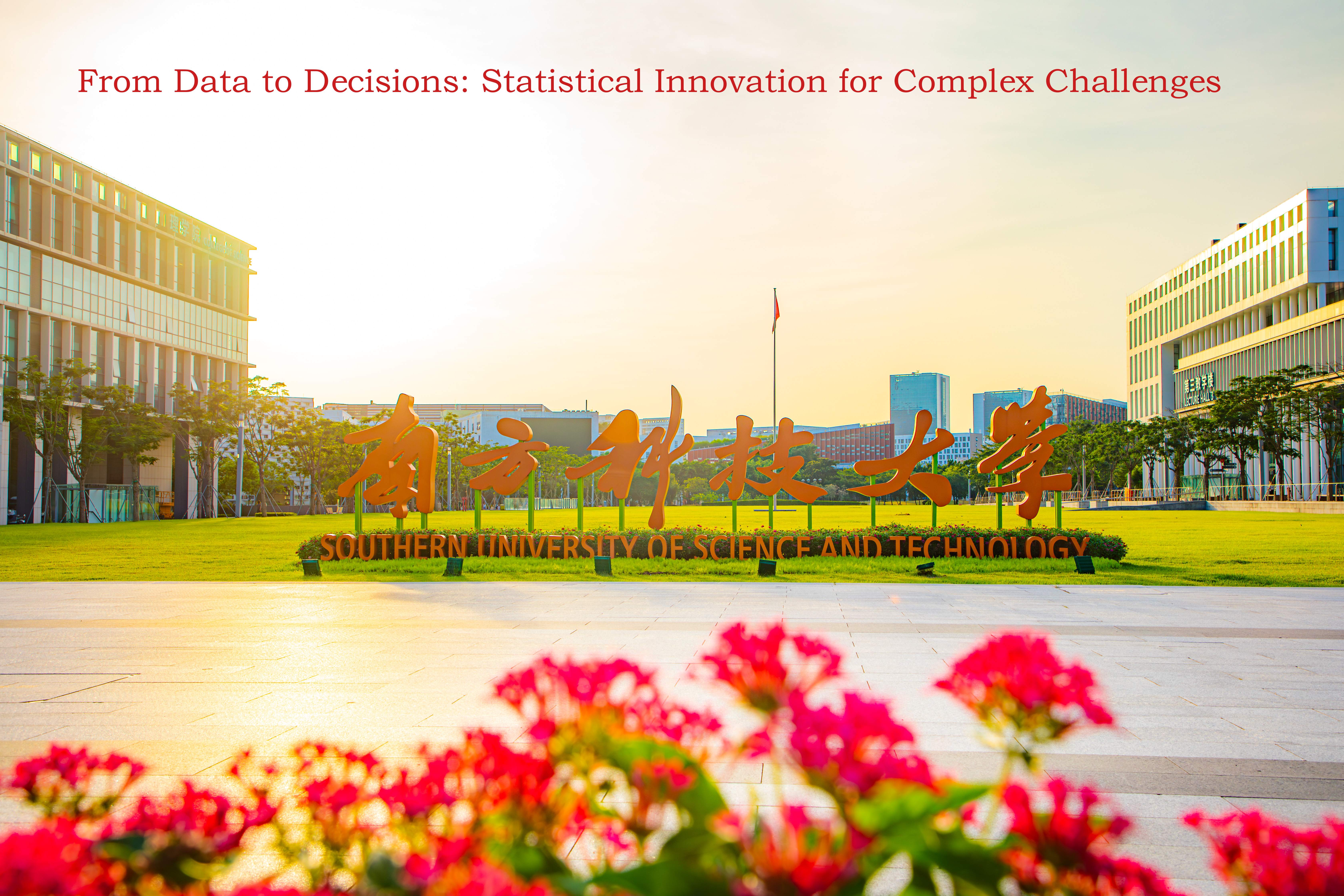
The 2026 ICSA China Conference will be held at Shenzhen, Guangdong Province, China from June 27 to June 29, 2026. It will be co-sponsored by Department of  Statistics and Data Science, Southern University of Science and Technology. The theme of this conference is "From Data to Decisions: Statistical Innovation for Complex Challenges". The conference venue is Southern University of Science and Technology.

KEY DATES REMINDER

Invited Session Proposals Submission Deadline: December 15, 2025

Short Course Proposals Submission Deadline: February 15, 2026

Early Bird Registration: April 15, 2026

Invited Session Abstracts Submission Deadline: April 30, 2026

Poster Abstracts Submission Deadline: April 30, 2026

Online Registration Submission Deadline: May 31, 2026


Registration & Submission
  • Conference Speakers: please complete the registration through a registration link which will be sent to you by email or through the link http://china2026.icsa.org/
  • Other Attendees: please complete the registration through the link http://china2026.icsa.org/
Executive Committee Members
Hongyu Zhao (Co-Chair) Yale University
Qiman Shao (Co-Chair) Southern University of Science and Technology
George C. Tseng University of Pittsburgh
Jun Zhao AbbVie
Scientific Program Committee
Jianguo Sun (Co-Chair) Southern University of Science and Technology
George C. Tseng (Co-Chair) University of Pittsburgh
Zhanrui Cai The University of Hong Kong
Jade (Huanyu) Chen Fortvita Biologics
Kun Chen University of Connecticut, Department of Statistics
Xuerong Chen Southwestern University of Finance and Economics
Yong Chen University of Pennsylvania, Department of Biostatistics
Mingyue Du Jilin University
Chiungyu Huang University of California, San Francisco, Department of Biostatistics
Jian Huang The Hong Kong Polytechnic University
Tao Hu Capital Normal University
Ching-Kang Ing National Tsinghua University (Taiwan)
Hongkai Ji Johns Hopkins University, Department of Biostatistics
Xuejun Jiang Southern University of Science and Technology
Chen-hung Kao Academia Sinica, Department of Statistics  (Taiwan)
Meiling Lee University of Maryland, Department of Biostatistics
Changcheng Li Dalian University of Technology
Gang Li University of California, Los Angeles, Department of Biostatistics
Huiqiong Li Yunnan University
Jessica Li Fred Hutchinson Cancer Center
Jialiang Li National University of Singapore, Department of Statistics
Lexin Li University of California, Berkeley, Department of Biostatistics
Huazhen Lin Southwestern University of Finance and Economics
Shili Lin The Ohio State University, Department of Statistics
Tsung-I Lin National Chung Hsing University  (Taiwan)
Qizhai Li Chinese Academy of Sciences, Academy of Mathematics and Systems Science
Quefeng Li University of North Carolina at Chapel Hill, Department of Biostatistics
Shuwei Li Guangzhou University
Ching-Ti Liu Boston University, Department of Biostatistics
Jingyuan Liu Xiamen University
Yanyan Liu Wuhan University
Zhigang Li University of Florida, Department of Biostatistics
Tianzhou Ma University of Maryland, Department of Biostatistics 
Li-Xuan Qin Memorial Sloan Kettering Cancer Center
Xinyuan Song The Chinese University of Hong Kong
Fasheng Sun Northeast Normal University
Liuquan Sun Chinese Academy of Sciences, Academy of Mathematics and Systems Science
Yuying Sun Chinese Academy of Sciences, Academy of Mathematics and Systems Science
Weijie Su University of Pennsylvania, Department of Statistics
Lu Tang University of Pittsburgh, Department of Biostatistics
Guoliang Tian Southern University of Science and Technology
Lu Tian Stanford University
Chunjie Wang Changchun University of Technology
Dehui Wang Liaoning University
Lu Wang University of Michigan, Department of Biostatistics
Ming Wang Case Western Reserve University, Department of Biostatistics
Peijie Wang Jilin University
Tianying Wang Colorado State University, Department of Statistics
Xueqin Wang University of Science and Technology of China
Yuanjia Wang Columbia University, Department of Biostatistics
Zhaojun Wang Nankai University
Yingying Wei The Chinese University of Hong Kong, Department of Statistics
Zheyang Wu Worcester Polytechnic Institute, Department of Mathematical Sciences
Fang Yao Peking University
Fengting Yi Yunnan University
Tianwei Yu The Chinese University of Hong Kong, Shenzhen, Department of Statistics
Anru Zhang Duke University, Department of Biostatistics
Tingting Zhang University of Pittsburgh, Department of Statistics
Xinyu Zhang Chinese Academy of Sciences, Academy of Mathematics and Systems Science
Hui Zhao Zhongnan University of Economics and Law
Shishun Zhao Jilin University
Xingqiu Zhao The Hong Kong Polytechnic University
Yichuan Zhao Georgia State University, Department of Statistics
Shurong Zheng Northeast Normal University
Shouhao Zhou The Pennsylvania State University, Department of Biostatistics
Xiang Zhou Yale University, Department of Statistics
Yong Zhou East China Normal University
Fukang Zhu Jilin University
Zhongyi Zhu Fudan University
Changliang Zou Nankai University
Guohua Zou Capital Normal University
IT and Website Committee
Chengsheng Jiang (Co-Chair)
Anqi Song (Co-Chair)
Southern University of Science and Technology
Shengjie Zhu
Southern University of Science and Technology
Local Organization Committee
Qiman Shao (Chair)
Southern University of Science and Technology
Xuejun Jiang (Co-Chair)
Southern University of Science and Technology
Chen GuanHua
Southern University of Science and Technology
Chen Xin
Southern University of Science and Technology
Hu Yanqing
Southern University of Science and Technology
Jiao Xiyun
Southern University of Science and Technology
Kong Fang
Southern University of Science and Technology
Li Zeng
Southern University of Science and Technology
Ma Yifang Southern University of Science and Technology
Shi Jianqingo Southern University of Science and Technology
Sun Jianguo Southern University of Science and Technology
Tao Yuxin Southern University of Science and Technology
Tian Guoliang Southern University of Science and Technology
Wang Chao Southern University of Science and Technology
Wei Hongxin Southern University of Science and Technology
Yang Lili Southern University of Science and Technology
Yang Linyi Southern University of Science and Technology
Yang Peng Southern University of Science and Technology
Zhang Haoran Southern University of Science and Technology
Zhang Zhuosong Southern University of Science and Technology


Junior Researcher Award Committee
Bin Zhang Cincinnati Children’s Hospital Medical Center
Xuejun Jiang Southern University of Science and Technology
Dayu Sun Indiana University
Short Course Committe
Zhixiang Lin (Chair) Chinese University of Hong Kong, Hong Kong
Ben Dai Chinese University of Hong Kong, Hong Kong
Cong Li Takeda pharmaceuticals, Boston, USA
Fangda Song Chinese University of Hong Kong, Shenzhen
Call for Junior Researcher Award
ICSA 2026 China Conference invites applications for Junior Researcher Award. Awardees 
will be selected from junior researchers who submit their papers for presentations at the 
conference to be held at Southern University of Science and Technology, Shenzhen, China 
during June 27 – 29, 2026. Students or Junior Researchers who received their degrees no earlier 
than January 1, 2021 are encouraged to submit a research paper on statistical methodology, 
novel application of statistical methods to problems in other disciplines, or other suitable 
contributions to statistics and data sciences. Jointly authored papers are acceptable, but the 
applicant is expected to be the lead author and present the work in the meeting. In addition, the 
applicant must be an active ICSA member or joins ICSA at the time of registration, and the paper 
must not be published or accepted before the application
Ø Application: 
Formal application consists of sending an e-mail to Dr. Bin Zhang at bin.zhang@cchmc.org with 
the subject title as “Application – ICSA 2026 China Conference Junior Researcher Award” with 
the following attachments (in PDF): 
1. A cover letter with contact information 
2. The curriculum vita of the applicant 
3. The manuscript of the completed research 
The application deadline is April 1, 2026
Ø Award: 
Papers will be reviewed by the Award Committee of the ICSA 2026 China Conference and about 
five award winners will be selected. Criteria for selection will include, but are not limited to, 
novelty in theory/methods/applications, significance and potential impact of the research, and 
clarity and well-writing in English. 
Ø Junior Researcher Award Committee: 
Xuejun Jiang, Southern University of Science and Technology
Dayu Sun, Indiana University


Junior Researcher Award Winners
Call for Invited Session Proposals
  • The 2026 ICSA China Conference is now accepting invited session proposals.
  • Each invited session consists of either 4 presenters or 3 presenters and 1 discussant.
  • Please submit the invited session proposal using the link https://china2026.icsa.org/invited-session-proposal/ before December 15, 2025.
  • Please note that each speaker in this conference can only give one invited talk.
Call for Short Courses
Download
Contact Us
  • Professor Xuejun Jiang , Southern University of Science and Technology, jiangxj@sustech.edu.cn
  • Lan Li, Southern University of Science and Technology, lil36@sustech.edu.cn
Important Notice

Dear Participants,

The ICSA 2026 China Conference will be held by the Department of Statistics and Data Sciences, Southern University of Science and Techonology. We extend our warm welcome to all distinguished guests. Please find below the relevant information for the conference:

Check-in Location: 

Check-in Time: 

Recently, conference-related information will be updated in real-time. Please pay close attention to it. Thank you for your cooperation!

Southern University of Science and Techonology


尊敬的嘉宾:


由南方科技大学统计与数据科学承办的2026国际泛华统计协会中国会议即将在南方科技大学举行,我们诚挚欢迎所有嘉宾的到来。以下为会议相关提示,请您悉知:

报到地点:

报到时间:

近期,会议相关信息会实时更新,请密切关注!谢谢您的支持!

南方科技大学

Keynote Speakers

Keynote Speakers

Speakers are listed in alphabetical order


lirz.jpg

Annie Qu, University of California


Title: Representation Retrieval Learning for Heterogeneous Data Integration

Abstract: In the era of big data, large-scale, multi-modal datasets are increasingly ubiquitous, offering unprecedented opportunities for predictive modeling and scientific discovery. However, these datasets often exhibit complex heterogeneity, such as covariate shift, posterior drift, and missing modalities which can hinder the accuracy of existing prediction algorithms. To address these challenges, we propose a novel Representation Retrieval (R2) framework, which integrates a representation learning module (the representer) with a sparsity-induced machine learning model (the learner). Moreover, we introduce the notion of “integrativeness” for representers, characterized by the effective data sources used in learning representers, and propose a Selective Integration Penalty (SIP) to explicitly improve the property. Theoretically, we demonstrate that the R2 framework relaxes the conventional full-sharing assumption in multi-task learning, allowing for partially shared structures, and that SIP can improve the convergence rate of the excess risk bound. Extensive simulation studies validate the empirical performance of our framework, and applications to two real-world datasets further confirm its superiority over existing approaches.


Annie Qu is Professor at the Department of Statistics and Applied Probability, University of California, Santa Barbara starting July 2025. She received her Ph.D. in Statistics from the Pennsylvania State University in 1998. Qu’s research focuses on solving fundamental issues regarding structured and unstructured large-scale data and developing cutting-edge statistical methods and theory in machine learning and algorithms for personalized medicine, text mining, recommender systems, medical imaging data, and network data analyses for complex heterogeneous data. Dr. Qu was a Data Science Founder Professor of Statistics and the Director of the Illinois Statistics Office at the University of Illinois at Urbana-Champaign during her tenure in 2008-2019, and Chancellor's Professor at UC Irvine in 2020-2025. She was a recipient of the NSF Career award from 2004 to 2009. She is a Fellow of the Institute of Mathematical Statistics (IMS), the American Statistical Association, and the American Association for the Advancement of Science. She is also a recipient of IMS Medallion Award and Lecturer in 2024. She served as Journal of the American Statistical Association Theory and Methods Co-Editor from 2023 to 2025, IMS Program Secretary from 2021 to 2027 and ASA Council of Sections of Governing Board Chair in 2025. She is the recipient of the 2025 Carver Medal of IMS.


lirz.jpg

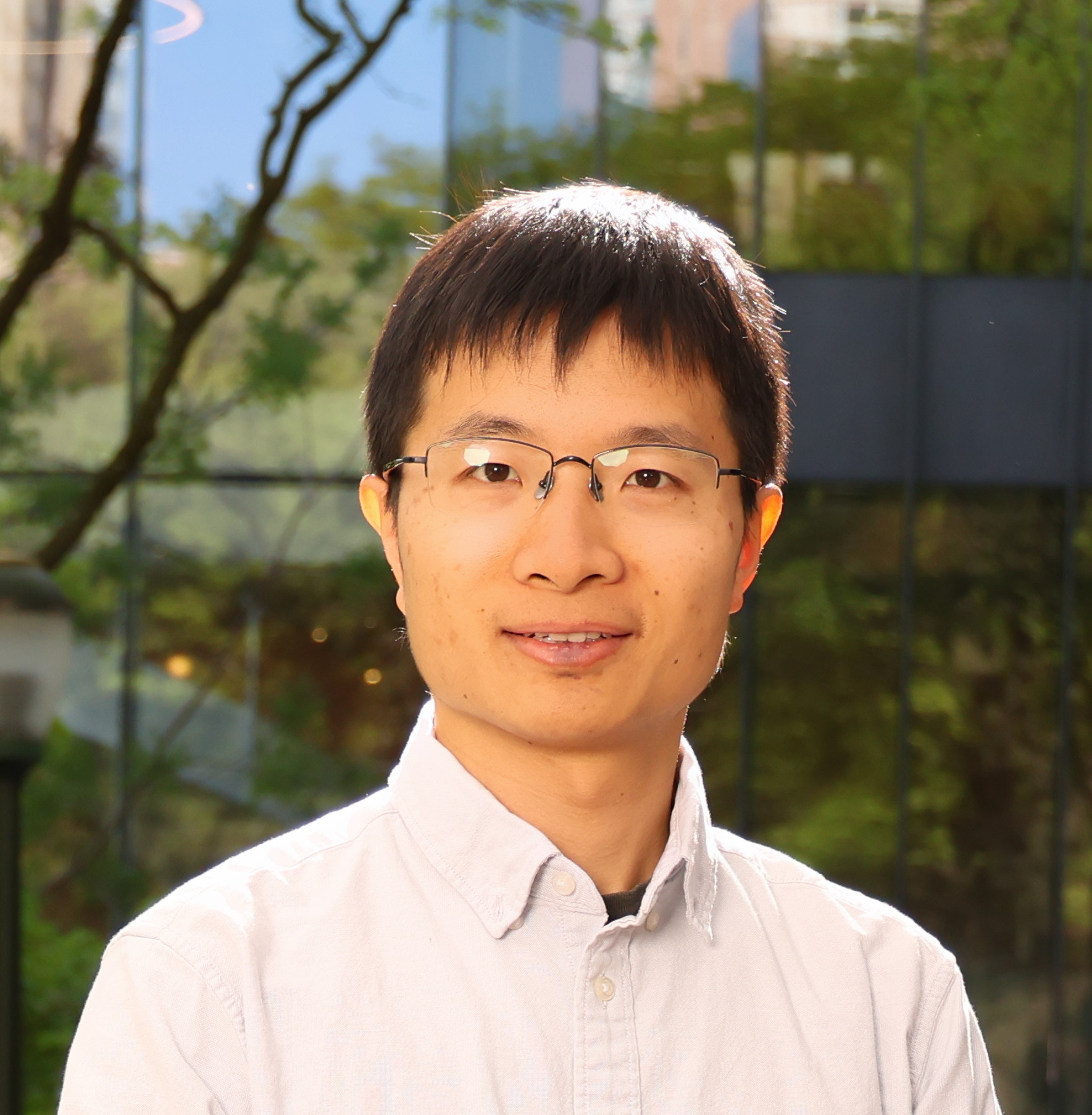
Weijie Su,  University of Pennsylvania

Title: Alignment in Large Language Models: Statistical and Game-Theoretic Perspectives

Abstract: Large language models (LLMs) are predominantly aligned with human preferences through reinforcement learning from human feedback (RLHF). In this talk, we explore the theoretical foundations of LLM alignment through the intertwined lenses of statistics and game theory. First, we show how the current formulation of RLHF induces a systematic bias we call preference collapse, and how this can be mitigated by introducing a tailored regularization term into the reward function. Next, we expose a fundamental bottleneck of reward-based alignment, demonstrating that cyclic human preferences cannot be faithfully represented by scalar reward models such as the Bradley-Terry model. More precisely, we establish that such cyclic inconsistencies give rise to a lower bound on the approximation error of any scalar reward fitting. Shifting to a game-theoretic perspective, we focus on Nash learning from human feedback and establish several social choice desiderata for this approach to alignment, including the preservation of preference diversity through the emergence of mixed strategies. Finally, we show that the zero-sum game approach generally cannot perfectly match a target preference distribution as a unique Nash equilibrium.


Weijie Su is an Associate Professor in the Wharton Statistics and Data Science Department and, by courtesy, in the Departments of Computer and Information Science, and Biostatistics, Epidemiology and Informatics, at the University of Pennsylvania. He serves as a co-director of the Penn Research in Machine Learning (PRiML) Center. Prior to joining Penn, he earned his PhD in from Stanford University in 2016 and his bachelor's degree from Peking University in 2011. His research interests include statistical foundations of generative AI, privacy-preserving data analysis, high-dimensional statistics, and optimization. He serves as a co-editor of Statistical Learning and Data Science (SLADS) and an associate editor of Journal of the American Statistical Association, Journal of Machine Learning Research, Annals of Applied Statistics, Operations Research, Harvard Data Science Review, and Foundations and Trends in Statistics. He is currently on the ICML 2026 Organizing Committee as the Scientific Integrity Chair.


lirz.jpg

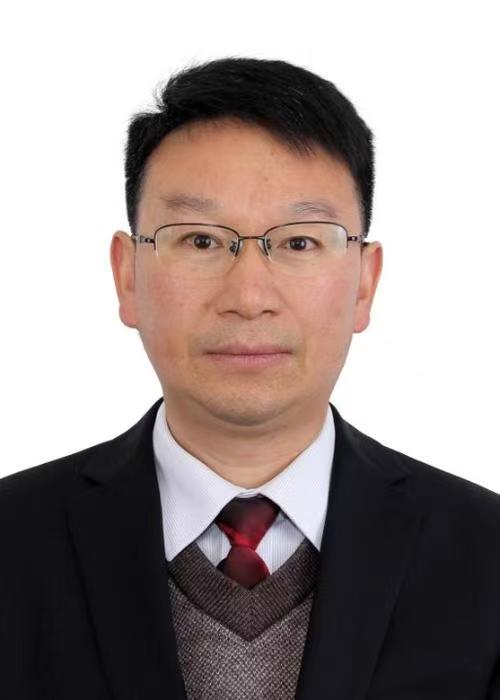
Niansheng Tang, Yunnan University

Variational Masking Generative Model for Anomaly Detection on Incomplete Tabular Data

Building anomaly detection models solely from normal data is crucial for many real-world applications. Existing deterministic autoencoder-based methods rely on reconstruction errors for anomaly detection but lack explicit modeling of probability distribution of the normal data. This limitation inherently hinders their performance and applicability when handling incomplete data. This paper proposes a novel Variational Masking Generative Model (VMGM) for tabular data anomaly detection. Specifically, we learn the data distribution via introducing learnable masks and modeling conditional distribution of the masked features of data given the unmasked features using a conditional diffusion model. By treating these masks as latent variables and approximating their intractable posterior with a variational posterior, we derive an evidence lower bound (ELBO) for the model. The learnable masks are sampled using differentiable Gumbel-Sigmoid reparameterization. This approach enables us to derive the parametric form of the ELBO for end-to-end model optimization. For anomaly detection, we construct a detection score based on the discrepancy between generated masked data and the ground-truth masked data. Extensive experiments on six diverse tabular datasets show that VMGM outperforms several state-of-the-art methods. Specifically, it improves AUROC and AUPRC by an average of 1.34% and 1.35%, respectively, over the leading baseline for anomaly detection on both complete and incomplete data.


简介:唐年胜,教授、博导,国家杰出青年科学基金获得者、教育部“长江学者”奖励计划特聘教授、国家百千万人才工程暨有突出贡献中青年专家享受国务院政府特殊津贴,国际统计学会推选会员、国际数理统计学会会士(IMS Fellow),国家自然科学基金委数学天元基金学术领导小组成员、教育部高等学校统计学类专业教学指导委员会委员。先后主持国家杰出青年科学基金、国家自然科学基金重点项目等基金;发表学术论文170余篇(其中SCI收录134篇),在科学出版社等出版学术专著4部、译著2部、教材1部,主编出版英文书籍2部;获省部级科技奖励10项。主要研究方向包括:大数据统计学习、贝叶斯统计分析、缺失数据分析、高维数据分析、生物统计等。


Jeremy Taylor, University of Michigan

Data integration: General concepts and specific methods.

I will consider the situation where you have a small or modest sized dataset and you wish to build a prediction model for the distribution of Y given covariates X and Z, where X and Z are low dimensional, with X being commonly collected and Z being only available in your dataset. You have external summary information from one or more studies about the distribution of Y given a subset of X. The individual data from these external studies is not available to you. The main goal is to improve the statistical efficiency of the model for Y given X and Z by making use of the external summary information. I will discuss empirical likelihood methods, Bayesian approaches, synthetic data methods and estimating equation approaches. Key concepts are the degree of similarity that could be assumed about the covariate distributions and the Y given X distributions, between the internal and external populations. Shrinkage approaches including James-Stein and Kullback-Leibler based shrinkage can be used to give estimators that are robust to population heterogeneity.


Jeremy M G Taylor obtained a Bachelor’s degree in Mathematics and a Diploma in Statistics from Cambridge University and a PhD in Statistics from University of California Berkeley. He was a faculty member in the Department of Biostatistics and the Department of Radiation Oncology at UCLA from 1983 to 1998. He is currently a Professor in the Department of Biostatistics and the Director of the Center for Cancer Biostatistics  at the University of Michigan. He is the winner of the Michael Fry award from the Radiation Research Society, the Mortimer Spiegelman award from the American Public Health Association, the Jerome Sacks award from the National Institute of Statistical Science and the Samuel Wilks award from the American Statistical Association. He has over 400 publications and research interests in longitudinal and survival data, cure models, methods for missing data, causal inference, biomarkers, clinical trials, surrogate and auxiliary variables and data integration. His current research mainly focusses on cancer research. He has served as the dissertation chair for 41 PhD students in Biostatistics at UCLA and the University of Michigan.


Short Courses

The 2026 ICSA China Conference will offer three optional short courses to be held on Friday 6/26. You may review the information for each short course below.

AM Short Course

C03. Statistical and Algorithmic Foundations of Diffusion Models
Time: 6/26 Friday 8:30AM-12:30PM (Half Day)
Abstract:
Diffusion generative models have emerged as a cornerstone of modern generative AI, delivering state-of-the-art performance across a wide range of data generation tasks. At their core, diffusion models seek to gradually transform pure noise into new data samples that emulate a target data distribution, accomplished by learning to reverse a forward stochastic process that progressively converts data into Gaussian noise. Despite their empirical successes, the statistical and algorithmic foundations of diffusion models remain far from mature. This lack of fundamental understanding limits their broader adoption, especially in applications that demand interpretability and reproducibility. 
 
This short course provides a timely introduction to diffusion models and presents recent progress toward understanding their striking effectiveness, with an emphasis on core principles and statistical insights. We will examine the fundamental mechanisms of score-based diffusion models; characterize the statistical limits of learning score functions; analyze the convergence behavior of diffusion-based samplers; explore how these models adapt to unknown low-dimensional data structures; discuss conditional generation via diffusion guidance; and highlight ideas for accelerating inference through higher-order approximations. Throughout this short course, we will connect theoretical advances to practical applications, illustrating how fundamental insights can inform effective algorithm design.
 
Lecturer 1: Yuxin Chen
Professor, Department of Statistics and Data Science
Wharton School at the University of Pennsylvania
 
Lecturer 2: Gen Li
Assistant Professor, Department of Statistics
Chinese University of Hong Kong
 
Lecturer 3: Yuting Wei
Associate Professor, Department of Statistics and Data Science
Wharton School at the University of Pennsylvania

PM Short Course

C01. Applied Meta-Analysis Using R
Time: 6/26 Friday 1:30PM-5:30PM (Half Day)
Abstract:
Meta-analysis integrates evidence from diverse studies to support more reliable and efficient inference. As the cost of medical and public health research continues to rise, many clinical studies are conducted with relatively small sample sizes, limiting their statistical power to detect clinically meaningful effects. This often leads to inconsistent or even conflicting findings across studies. By synthesizing effect estimates from multiple investigations using meta-analytic techniques, researchers can effectively increase the overall sample size, improve statistical power, and generate more precise and generalizable conclusions. Given its substantial impact on evidence-based practice, methodological choices in meta-analysis have received increasing attention, and the development of new methods and software has become a rapidly expanding area of research.
 
This half-day short course provides a comprehensive overview of meta-analysis, covering both the theoretical foundations of common meta-analytic models and their practical implementation in the widely used, freely available software R. Drawing on real-world examples from medical and public health research, the course will guide participants through step-by-step analyses using appropriate R packages and functions, offering both conceptual understanding and hands-on experience. Prior knowledge of R is helpful but not required.
 
Lecturer: Yan Ma
Professor and Chair, Department of Biostatistics and Health Data Science
University of Pittsburgh

Full Day Short Course

C02. Bayesian Adaptive Designs for Oncology Clinical Trials
Time: 6/26 Friday 8:30AM-4:30PM (Full Day)
Abstract:
In this short course, we will delve into Bayesian clinical trial designs and their implementation, with a focus on early phase trials. We will first examine phase I dose finding and optimization trial designs. Our focus will be on model-assisted designs, which offer simplicity, flexibility, and excellent operating characteristics. We will also highlight state-of-the-art designs that support this effort. We will use real-world trial examples to illustrate these novel designs using freely available software. 
 
Moving on to phase II trial design, we will introduce the Bayesian phase II design and demonstrate its practical application. Additionally, we will cover biomarker-based designs, such as enrichment and marker-stratified designs. We will explain the fundamental principles of Bayesian monitoring and decision-making, with a particular focus on sharing practical experience with the BOP2 design and its applications.
 
Furthermore, master protocol designs have developed rapidly and have been widely adopted in recent years. We will discuss the application of Bayesian approaches from the perspective of adaptive elements in master protocol designs, with particular emphasis on basket trials and platform trials. The focus of this short course is to bridge the gap between theoretical understanding and practical application. By the end of the course, attendees will have a solid understanding of how to implement Bayesian clinical trial designs in their own research.
 
Lecturer 1: Yong Zang
Associate Professor, Department of Biostatistics and Health Data Science
Co-Director of Clinical Research for the Biostatistics and Data Management Core, IU Simon Comprehensive Cancer Center
Indiana University School of Medicine
 
Lecturer 2: Fangrong Yan
Professor and Doctoral Supervisor, Director of the Department of Biostatistics
Director of the Center for Biostatistics and Computational Pharmacy
China Pharmaceutical University
 
Lecturer 3: Wenyun Yang
Ph.D. candidate
Department of Biostatistics
China Pharmaceutical University

Accommodation

Accommodation


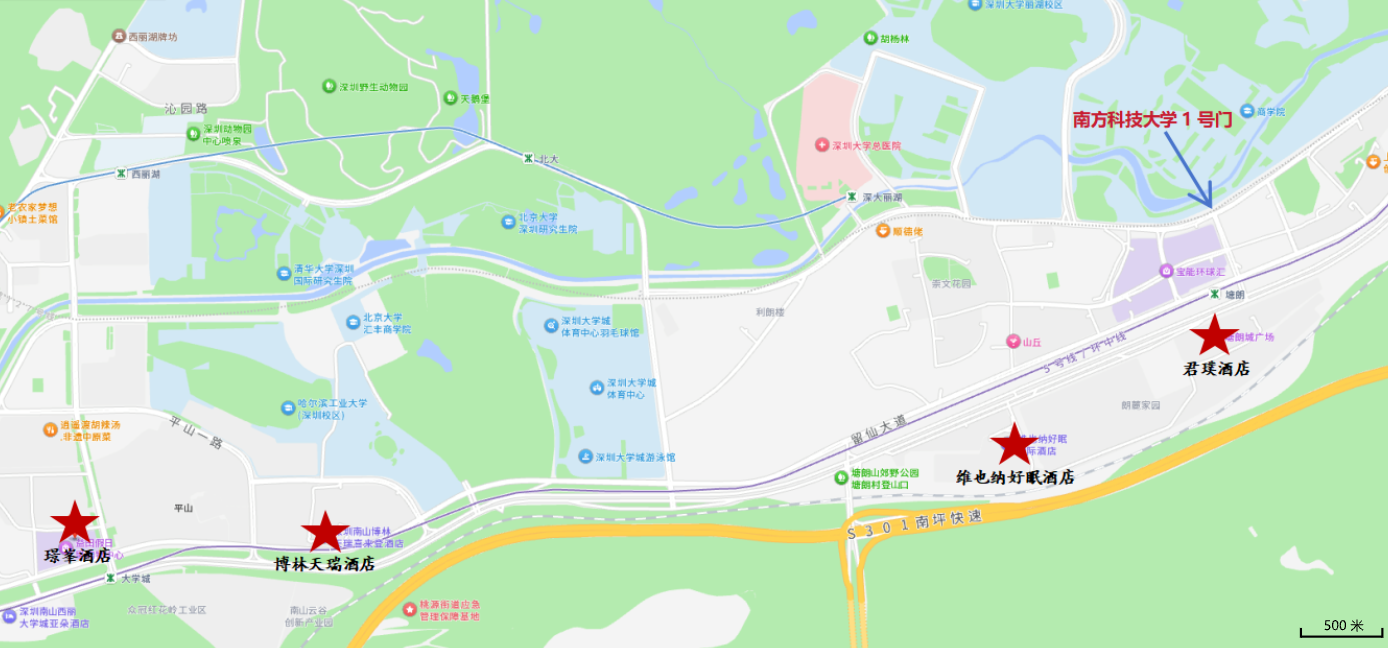
The 2026 ICSA China Conference will be held at Southern University of Science and Technology, with the main conference taking place from June 27 to June 29. It is recommended that the participants may make room reservation. The organizing committee has recommended hotels with negotiated rates, but please note that these rates may not necessarily be the lowest. We encourage all participants to compare prices on other platforms to make the most favorable choice for themselves. For hotel information. Please refer to the table below for hotel information.


Special reminder: When booking and checking into hotels, please remind the service personnel that we are here to attend the 2026 ICSA China Conference to avoid missing the negotiation price. Please make reservations as early as possible, preferably by phone.

Hotel Information:

  Hotel  Room Type quantity (rooms) price contact person location
1 Genpla Hotel Shenzhen Nanshan double bed 70 RMB 680/day/single breakfast Room reservation hotline: 18385269678
(Manager Zhou)
Floors 6-16, Tower C, West Area of Tanglang City, No. 3333 Liuxian Boulevard, Nanshan District, Shenzhen
twin beds 50 RMB 768/day/two breakfasts
2 Vienna Good Sleep International Hotel (Tanglang Subway Station) double bed 90 RMB 448/day/two breakfasts Room reservation hotline: 19874134572
(Manager Zhou)
Next to Liuxian Boulevard, Nanshan District, Shenzhen
twin beds 80 RMB 438/day/double breakfast
3 Shenzhen Nanshan Jingfeng Hotel (Xili University Town Branch) double bed 280

Double room, 388 yuan per day without breakfast

Double room, 428 yuan/day/single breakfast

Double bed room, 468 yuan/day/two breakfasts

Room reservation hotline: 13728828561
(Manager Jin) 
Tower B, Zhongguan Times Square, No. 4168 Liuxian Boulevard, Nanshan District, Shenzhen
twin beds 30

Twin room, 428 yuan per day without breakfast

Twin room, 508 yuan per day with breakfast


4
Sheraton Shenzhen Nanshan double bed 70

RMB 1000/day/single breakfast

Room reservation hotline: 13923841909
(Manager Yang)

No. 4088 Liuxian Boulevard, Nanshan District, Shenzhen

twin beds 80

RMB 1100/day/single breakfast

Total     750    


2026国际泛华统计协会中国会议将在南方科技大学举行,主会议将于6月27日至6月29日召开。建议参会者提前预订房间。组委会已推荐了协商价格的酒店,但请注意,这些价格可能并非最低。我们鼓励所有参会者比较其他平台的价格,以做出对自己最有利的选择。有关酒店信息,请参阅下表。

特别提醒:参会人员预订和入住酒店时,请提示服务人员是来参加2026国际泛华统计协会中国会议的,以免错失协议价。请与会人员尽早预定,最好通过电话预定。

酒店信息


酒店

房间类型

数量(间)

价格

联系方式

位置
1

深圳南山深铁塘朗城君璞酒店

大床

70

680元/天/单早


订房电话:18385269678

(周经理)


深圳市南山区留仙大道3333号塘朗城西区C座6-16楼

双床

50 768元/天/双早
2

维也纳好眠国际酒店(塘朗地铁站店)

大床 90 448元/天/双早 订房电话:19874134572
(周经理)
深圳市南山区留仙大道旁
双床 80

438元/天/双早

3

深圳璟峯酒店(西丽大学城店)

大床

280

大床房,388元/天/无早餐

大床房,428元/天/单早

大床房,468元/天/双早

订房电话:13728828561

(金经理)

深圳市南山区留仙大道4168号众冠时代广场B座

双床

30

双床房,428/元/天/无早

双床房,508/元/天/双早

4

深圳南山博林天瑞喜来登酒店

大床

70

1000元/天/单早

订房电话:13923841909

(杨经理)

深圳市南山区留仙大道4088号

双床

80

1100/元/天/双早

合 计


750    


Transportation

Transportation


 交通指南/ Transportation Guide

会务信息/ Venue Information

会议地点:南方科技大学

会议地址:广东省深圳市南山区桃源街道福光社区学苑大道1088号

Meeting Venue: Southern University of Science and Technology

Meeting Address: No. 1088, Xueyuan Avenue, Fuguang Community, Taoyuan Street, Nanshan District, Shenzhen City, Guangdong Province


入住酒店:  君璞酒店、维也纳酒店、璟峯酒店、博林天瑞酒店

入住时间:2026年6月26日-6月28日

Hotel check-in: Junpu Hotel、Vienna Hotel、Jingfeng HotelBolin Tianrui Hotel

Check-in period: June 26- June 28, 2026


交通指引/Transportation Guide


一、主要交通枢纽到达方案(Arrival Options from Major Transportation Hubs

      1.深圳宝安国际机场 → 南方科技大学

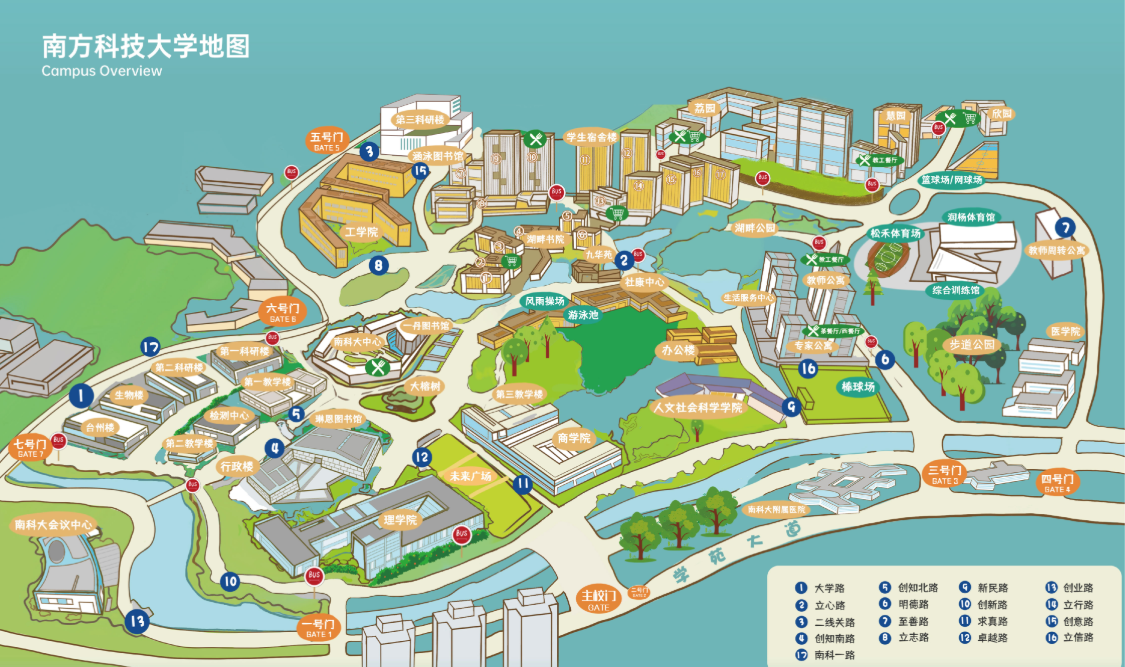
              A.地铁(约70分钟,费用约10元):机场步行至机场站——乘坐11号线(往岗厦北方向)至前海湾站——换乘5号线(往黄贝岭方向)至塘朗站C出口。(提示:C出口正对南科大校园,出站后沿学苑大道步行约300米即到1号门。) 

               B.出租车/网约车(约40-60分钟,费用约120-150元): 目的地请设——南方科技大学1号门或2号门


      1. Shenzhen Bao'an International Airport → Southern University of Science and Technology
               A. Metro​ (approx. 70 minutes, fare approx. ¥10):Walk to Airport Station​ at the airport → Take Line 11​ (towards Gangxia North) to Qianhaiwan Station​ → Transfer to Line 5​ (towards Huangbeiling) and alight at Tanglang Station, Exit C.(Note: Exit C faces the SUSTech campus. Walk about 300 meters along Xueyuan Avenue to reach Gate 1.)

               B. Taxi/Ride-hailing​ (approx. 40–60 minutes, fare approx. ¥120–150):Set your destination as: Southern University of Science and Technology, Gate 1 or Gate 2.


       2.深圳北站(高铁站) → 南方科技大学

               A.地铁(约20分钟,费用约5元):深圳北站内直接进入深圳北站地铁站——乘坐5号线(往赤湾方向)至塘朗站C出口。(提示:C出口正对南科大校园,出站后沿学苑大道步行约300米即到1号门)

               B.出租车/网约车(约15-20分钟,费用约25-35元):

              上车点——深圳北站西广场或东广场出租车场。

              目的地——南方科技大学1号门或2号门


       2. Shenzhen North Railway Station (High-Speed Rail) → Southern University of Science and Technology
               A. Metro​ (approx. 20 minutes, fare approx. ¥5):Enter Shenzhen North Station Metro​ inside the railway station → Take Line 5​ (towards Chiwan) to Tanglang Station, Exit C.(Note: Exit C faces the SUSTech campus. Walk about 300 meters along Xueyuan Avenue to reach Gate 1.)
               B. Taxi/Ride-hailing​ (approx. 15–20 minutes, fare approx. ¥25–35):
               Pick-up locations—— Taxi stands at the West Plaza or East Plaza of Shenzhen North Station.

               Destination:——Southern University of Science and Technology, Gate 1 or Gate 2.


       3.市内乘坐公交车方案

               南方科技大学站(最近,正对1号门) 途经线路:M369路、B818路、81路、122路、37路、49路等。 下车后:步行约1分钟即可到达1号门。

               塘朗地铁站(公交站)(近地铁C出口,步行至1号门约5分钟) 途经线路:M369路、B818路、81路、M393路、M535路、B667路等。 下车后:沿学苑大道向东步行约300米至1号门。

               学苑大道东站(近2号门/校内宿舍区) 途经线路:M369路、B818路、81路、122路等。 下车后:步行约3分钟至2号门。


       3. Arrival by City Bus

               Southern University of Science and Technology Bus Stop​ (closest, directly facing Gate 1) Routes:​ M369, B818, 81, 122, 37, 49, etc. After getting off:​ Walk about 1 minute to Gate 1.

               Tanglang Metro Station Bus Stop​ (near Metro Exit C, about 5 minutes’ walk to Gate 1) Routes:​ M369, B818, 81, M393, M535, B667, etc. After getting off:​ Walk east along Xueyuan Avenue about 300 meters to Gate 1.

               Xueyuan Avenue East Bus Stop​ (near Gate 2 / campus dormitory area) Routes:​ M369, B818, 81, 122, etc. After getting off:​ Walk about 3 minutes to Gate 2.


注:乘坐公交或地铁方法(By Bus or Metro

使用微信APP搜索或扫描深圳通小程序(Use the WeChat app to search for or scan the Shenzhen Tong mini-program.)               


在应用商城下载深圳通APP或扫描二维码下载(Download the Shenzhen Tong app from the app store or scan the QR code to install.)


也可直接使用零钱现金到站台购票(You can also purchase tickets directly with cash at the station.)


二、 自驾车提示(Notes for Self-Driving Visitors​

          校外车辆入校需提前联系会务组报备车牌号,否则无法进入。临时车辆可停校外周边公共停车场(车位紧张)。

          校内停车场:报备车辆可从1号门或2号门进入,按指引停至指定区域(如中心停车场)。

          导航设置:请直接设置“南方科技大学1号门”(学苑大道主入口)。

          Entry for external vehicles:License plate numbers must be registered in advance with the conference organizing team; otherwise, entry is not permitted. Temporary vehicles may park in public parking lots around the campus (parking spaces are limited).

          On-campus parking:Registered vehicles can enter through Gate 1 or Gate 2 and park in designated areas (e.g., the central parking lot) as guided.

          Navigation setup:Please set the destination directly as “Southern University of Science and Technology, Gate 1” (main entrance on Xueyuan Avenue).


三、 温馨提示(Friendly Reminders

          高峰期避开拥堵:深圳早高峰(7:30-9:00)、晚高峰(17:30-19:00)拥堵严重,请来宾尽量选择地铁,并预留充足时间。

          天气与装备:深圳天气多变,夏季多雨,请随身携带雨具;校内步行距离较长,建议穿着舒适便鞋。

          入校凭证:请务必携带会议邀请函/二维码等凭证,以备门岗查验。

          Avoid Peak-Hour Traffic:Shenzhen experiences severe congestion during morning peak hours (7:30–9:00) and evening peak hours (17:30–19:00). We recommend that guests take the metro and allow ample travel time.

         Weather and Attire:Shenzhen weather is changeable, with frequent rain in summer. Please carry rain gear. As walking distances on campus can be considerable, comfortable shoes are advised.

         Campus Entry Pass:Please be sure to bring your conference invitation letter, QR code, or other credentials for verification at the entrance checkpoint.


Info Service

Info Service

医疗信息

1.紧急电话

紧急情况下,请优先拨打120寻求医疗急救。尽可能清晰地告知您的具体位置(酒店名称、会议中心名称及区域、附近标志性建筑等)。

学校保卫办24小时报警求助电话:0755-8801 0110


2.推荐医院

1)南方科技大学校医院

电话:0755-88010120

地址:校内学生宿舍11栋101。

2)香港大学深圳医院

地址:深圳市福田区海园一路1号。

优势:公立三甲医院,科室齐全,急诊与重症救治能力强,拥有国际医疗部,涉外经验丰富。

3)南方医科大学深圳医院

地址:深圳市宝安区新湖路1333号。

优势:公立三甲医院,依托南方医科大学,医疗水平较高,部分科室特色突出。


3.药店

1)校园内药店(南科大教育超市内)

地址:南方科技大学校内教育超市内。

2)校外连锁药店(例如:海王星辰健康药房-塘朗店)

地址:南山区学苑大道塘朗城或附近社区底商(可使用地图APP搜索“药店”获取最近点位)。

建议携带足够整个行程所需的个人处方药,并保留原包装和医生处方。了解中国对入境药品的规定(尤其含麻醉、精神类成分的药品),避免携带违禁品。

Medical Information

1. Emergency Phone

In case of emergency, please call 120 for medical assistance first. Please give your exact location as clearly as possible (hotel name, conference center name and area, nearby landmarks).

The 24-hour alarm and help number of the Campus Security Office: 0755-88010110


2. Recommended Hospitals

(1)Southern University of Science and Technology (SUSTech) Campus Clinic

Tel: 0755-88010120.

Room 101, Building 11, Student Dormitory, on campus.

(2)The University of Hong Kong-Shenzhen Hospital

Address: No. 1, Haiyuan 1st Road, Futian District, Shenzhen.

Advantages: A public Grade A tertiary hospital with comprehensive departments, strong emergency and critical care capabilities. It has an International Medical Department and extensive experience in serving international patients.

(3)Southern Medical University Shenzhen Hospital

Address: No. 1333, Xinhu Road, Bao'an District, Shenzhen.

Advantages: A public Grade A tertiary hospital affiliated with Southern Medical University, offering high medical standards and expertise in specialized departments.


3. Pharmacies

(1)On-Campus Pharmacy (inside the SUSTech Educational Supermarket)

Address:  Inside the SUSTech Educational Supermarket on campus.

(2)Off-Campus Chain Pharmacy (e.g., Nepstar Star Health Pharmacy - Tanglang Store)

Address: Located in Tanglang City or nearby community storefronts along Xueyuan Avenue, Nanshan District (use a map app to search for the nearest "pharmacy").

It is recommended to carry enough personal prescription drugs for the whole trip, and keep the original packaging and doctor's prescription. Understand China's regulations on imported drugs (especially those containing narcotic and psychotropic ingredients), and avoid carrying prohibited items or excessive amounts.


天气须知

1.天气概况

(1)温度

日间温度通常在 30°C-35°C (86°F-95°F) 之间,夜间温度通常在 26°C-30°C (79°F-86°F) 之间。体感温度因高湿度可能更高。

(2)降水

会议期间(夏季)为深圳高温多雨季节,多突发性短时雷阵雨,常见于午后或傍晚,偶有持续性强降雨。降水概率较高,出行需做好防雨准备。

(3)日照与湿度

降雨间隙常伴随强烈日照与高紫外线指数,空气湿度普遍较高(平均约80%)。闷热感明显,需注意防暑。

建议:建议随时关注深圳气象局发布的实时天气预报,合理规划出行时间。高温时段尽量减少户外停留,如出现头晕、乏力、恶心等中暑症状,请立即至阴凉处休息、补水并及时求助。

2.台风应对

深圳夏季为台风多发期,请密切关注气象部门发布的台风预警信号(蓝色 → 黄色 → 橙色 → 红色,红色为最高级别)。

遵循会议组织方与当地应急部门的指引。

台风影响期间尽量避免外出,留在坚固的室内,远离门窗。

提前了解会议地点及住宿场所的应急疏散路线。

建议:会前一周起,可通过 “深圳天气”官方APP、中国气象局官网、香港天文台 等渠道持续关注天气动态与台风路径预报。

3.着装与装备建议

衣物:以轻薄、速干、透气的短袖衣物为主,可备长袖薄外套或防晒衣(用于室内强冷空调环境及户外防晒)。

鞋袜:建议穿着舒适、透气的步行鞋,可备一双防水或速干鞋应对雨天。多备几双棉质袜子。

雨具:推荐携带抗风折叠伞或轻便雨衣(深圳降雨常伴随阵风)。

防晒:高倍数防晒霜(SPF50+ PA+++)、太阳镜、遮阳帽或晴雨两用伞。

防蚊虫:深圳夏季蚊虫较多,建议使用含 避蚊胺(DEET)派卡瑞丁(Picaridin) 成分的驱蚊产品。

其他:便携小风扇、水壶、纸巾及湿巾、充电宝、常用防暑药品(如藿香正气水等)。

Weather Notice

1. Weather overview

(1)Temperature

Daytime temperatures are typically between 30°C-35°C (86°F-95°F), while nighttime temperatures generally range from 26°C-30°C (79°F-86°F). The high humidity may make it feel even hotter.

(2)Precipitation

During the conference period (summer), Shenzhen experiences hot and rainy weather, with frequent short but heavy thunderstorms, often occurring in the afternoon or evening. There is also a possibility of prolonged heavy rainfall.

(3)Sunshine & Humidity

Intervals between rainfall are often accompanied by intense sunshine and high UV radiation, with generally high humidity levels (averaging around 80%). The combination of heat and humidity can be particularly noticeable.

Suggestion:  Please check real-time weather updates from the Shenzhen Meteorological Bureau frequently and plan your travel accordingly. During peak heat hours, minimize outdoor activities. If symptoms of heatstroke such as dizziness, fatigue, or nausea occur, move to a shaded area immediately, hydrate, and seek assistance if needed.

2. Typhoon response

Shenzhen’s summer is a typhoon-prone season. Please pay close attention to typhoon warning signals issued by meteorological authorities (Blue → Yellow → Orange → Red, with Red being the highest level).

Follow instructions from the conference organizers and local emergency authorities.

During typhoon impacts, avoid unnecessary outings and stay indoors away from windows and doors.

Familiarize yourself with emergency evacuation routes at the conference venue and your accommodation in advance.

Suggestion: Starting one week before the conference, stay updated via the "Shenzhen Weather" official app, the China Meteorological Administration website, or the Hong Kong Observatory for the latest forecasts and typhoon tracking information.

3. Dressing and Equipment Suggestions

Clothing: Lightweight, quick-dry, and breathable short-sleeved tops are recommended. Bring a long-sleeved layer or sun-protective clothing for strong air-conditioning indoors and sun protection outdoors.

Shoes and socks: Comfortable, breathable walking shoes are advisable. Waterproof or quick-dry shoes may be useful for rainy days. Bring extra pairs of cotton socks.

Rain gear: A wind-resistant folding umbrella or a lightweight raincoat is recommended (rain in Shenzhen is often accompanied by gusts).

Sun protection:High-SPF sunscreen (SPF50+ PA+++), sunglasses, and a wide-brimmed hat or a dual-use sun/rain umbrella.

Mosquito repellent: Mosquitoes are common in Shenzhen during summer. Use repellents containing DEET or Picaridin for better effectiveness.

Others: Portable fan, water bottle, tissues/wet wipes, power bank, and common heatstroke prevention medicines (e.g., Huoxiang Zhengqi Shui).

Program

Program